


Combining facts from the Central Statistical Office with knowledge about geopolitical trends gives a fuller picture of the reality in which Polish companies operate. What challenges and opportunities does this new reality bring? What decisions are worth making in order to gain an advantage in the market? Let's find out.
Private entrepreneurship – a pillar of the Polish economy
The general structure and the predominant role of private entrepreneurship
According to data from the Central Statistical Office, as many as 95% of all business entities operating in Poland are private companies, which means more than 5 million enterprises. Such a large number testifies to a strongly developed culture of entrepreneurship and to the resilience of the private sector to changing geopolitical and economic conditions.
In the face of challenges such as the war in Ukraine or US–China tensions, private companies play a key role in the stability of the Polish economy. Their flexibility and diversity are essential. These companies are an important source of jobs and innovation. They also have a significant share in creating GDP. This confirms their fundamental importance for the country's economic development.
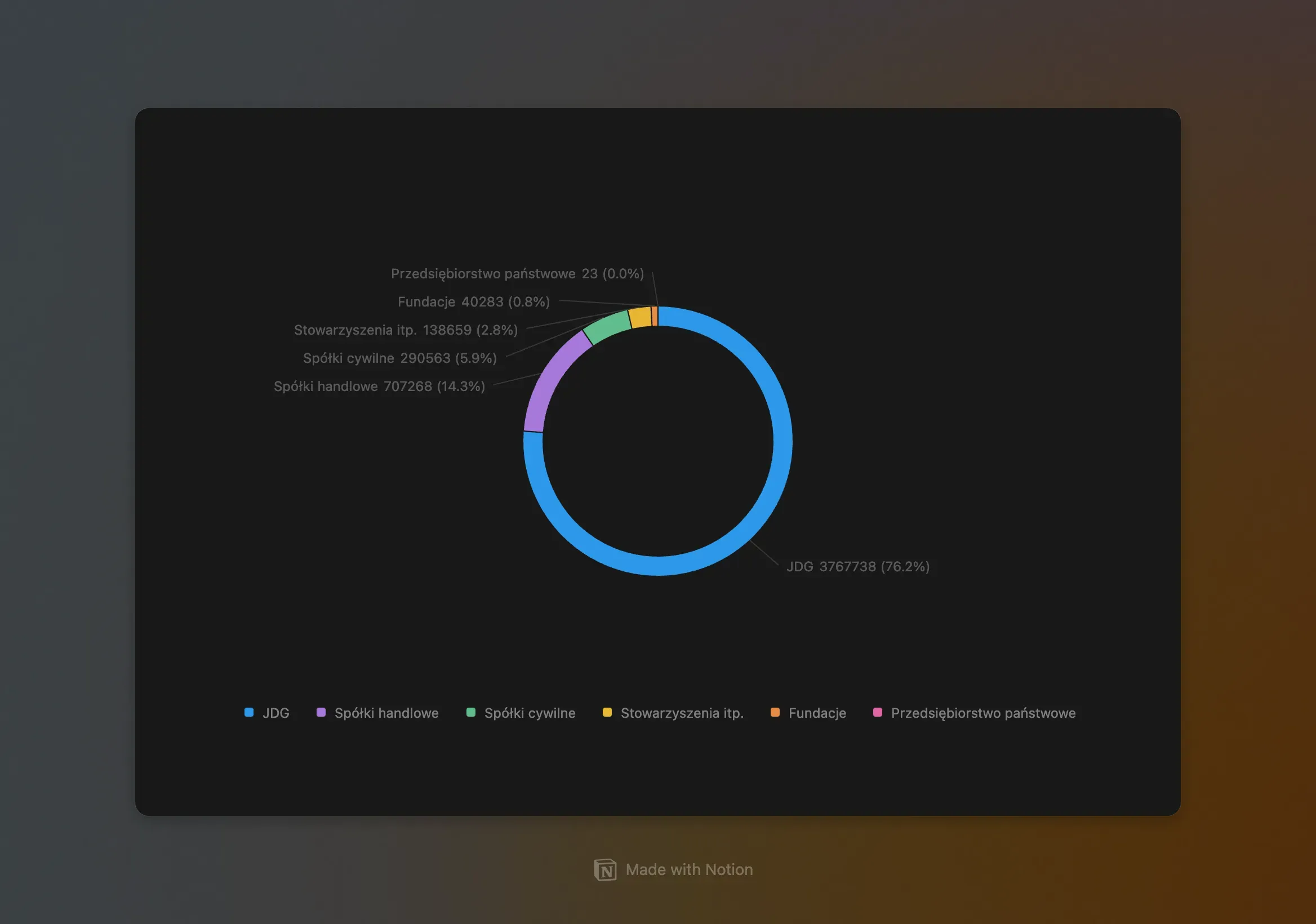
The percentage share of individual ownership sectors in the Polish national economy reveals a clear disproportion. The public sector is represented by only 2% of all entities. It includes state-owned enterprises and those belonging to local government units. The remaining 3% of entities are classified in the "other" category, which includes, among others, cooperatives, foreign enterprises not classified as private, and other forms of mixed ownership.
The Polish economy is based mainly on private initiative and capital. Although the public sector is small in terms of the number of entities, it can play a strategic role in the economy. This applies in particular to areas such as infrastructure or energy, where the state's share is sometimes crucial. It is worth noting that the government may seek to strengthen the state's role in sectors of strategic importance. This is confirmed by statements by Prime Minister Donald Tusk about the need for "re-Polonisation" and the protection of national interests. State Treasury companies are of particular importance here, as they may be treated as a priority. Nevertheless, the numerical data and graphic visualisations indicate the dominant role of the private sector. It is private entrepreneurship that forms the foundation of the Polish economy.
Regional economic activity
The Polish business map clearly shows that not all voivodeships are developing at the same pace, and regional differences can be surprising. GUS data from February 2025 says unequivocally – the centre of gravity of Polish entrepreneurship is in Mazovia, where more than a million companies operate. That is almost 20% of all active business entities in the country. Next come Silesia, Greater Poland and Lesser Poland – strong, developed regions with more than half a million companies each.
But the data from the other end of the table are equally interesting – voivodeships such as Opole, Podlaskie and Holy Cross have decidedly fewer registered companies, which may mean less competition, but also less developed business infrastructure.
| Voivodeships | Number of private entities |
|---|---|
| Lower Silesian | 457,474 |
| Kuyavian-Pomeranian | 230,349 |
| Lublin | 216,920 |
| Lubusz | 134,719 |
| Łódź | 290,579 |
| Lesser Poland | 501,508 |
| Masovian | 1,057,965 |
| Opole | 114,928 |
| Subcarpathian | 214,673 |
| Podlaskie | 123,934 |
| Pomeranian | 370,849 |
| Silesian | 546,243 |
| Holy Cross | 132,121 |
| Warmian-Masurian | 150,304 |
| Greater Poland | 520,063 |
| West Pomeranian | 255,412 |
| Total | 5,318,041 |
Why does this matter? Because the choice of investment or expansion location can decide the success of an entire project. Is it worth betting on already developed centres with strong competition? Or perhaps it is better to look for opportunities where the market is only just gaining momentum? Understanding these local differences is the first step to accurate business decisions.
Sectoral structure: dominance of services and industry, but with significant growth in innovation
An overview of key sectors of activity and their contribution to the economy
Although Mazovia, Silesia and Greater Poland are powerful engines of Polish business, it is equally interesting to see what Polish companies do. Trade, manufacturing and construction are still the pillars of our economy, but technology-based sectors are also breaking through ever more strongly – from finance, through e-health, to business services. Poland is not only selling excellent furniture or food abroad – it is increasingly exporting know-how and innovation too. This is a sign that the transformation is already underway and has no intention of slowing down.
Dominant sectors and their importance for the Polish economy
GUS data show the dominance of the trade, construction and manufacturing sectors among Polish companies. These industries have formed the foundation of the national economy for years. Services also have a large share. Digital technologies and business services are growing dynamically. It is precisely in these sectors that opportunities to obtain public funds appear. These concern national and EU funds. They are intended for business development, innovation and digitalisation. The correlation between scale and the availability of financing makes these sectors attractive for investment. They are also of great importance in strategic planning.
A study of the landscape of legal forms adopted by Polish entrepreneurs
More and more Polish entrepreneurs are betting on simplicity – the sole proprietorship still leads the way, mainly thanks to the ease of registration and low costs. But a new trend is growing in the background: limited liability companies are being chosen more and more often, especially where greater risks and the need for tax optimisation are involved. The legal form today is not just a formality – it is a strategic choice that says a lot about a company's ambitions.
| Form of activity | For whom? | Advantages | Disadvantages |
|---|---|---|---|
| Sole proprietorship (JDG) | People starting a business, freelancers, micro-companies | – Simple registration<br>– Low costs<br>– Reliefs (Small ZUS, start-up relief)<br>– Full control | – Liability with one's entire assets<br>– Less attractive for larger contracts |
| Limited liability company (sp. z o.o.) | Start-ups, companies planning to grow, partners wanting to limit risk | – Limited liability<br>– Possibility of founding it on one's own<br><br>– Credibility | – More formalities<br>– Full accounting<br>– Higher registration and operating costs |
| Civil partnership (s.c.) | Small entrepreneurs cooperating with each other | – A simple form of cooperation<br>– Low costs<br>– The possibility of acting together without establishing a commercial company | – No legal personality<br>– Partners are liable with their personal assets |
Strategic adaptation: resilience, innovation and digital transformation
Polish enterprises, particularly small and medium-sized ones (SMEs), must quickly adapt to a changing geopolitical and economic environment. In the face of unpredictable crises such as the war in Ukraine, well-considered adaptation strategies are necessary. An additional challenge is the changes in trade policy between the USA and China, which affect global supply chains. In this context, three strategies become crucial and can form the foundation of companies' resilience and competitiveness. First – diversification of markets and supply chains, reducing dependence on a single region or trading partner. Second – digital transformation, which enables process automation and increased operational efficiency of enterprises. Third – investment in innovation and cooperation with start-ups, which fosters the implementation of new technologies and business models.
1. Diversification of markets and supply chains
As a result of global tensions, companies dependent on a single market or supplier are at serious risk of disruption to their operations. Diversification is the answer to these threats, both in terms of markets and sources of supply.
Benefits of diversification:
- Risk reduction: Diversifying suppliers and markets allows you to minimise the risk associated with supply chain interruptions, e.g. as a result of political changes, attacks or sanctions.
- Increased flexibility: Companies operating in multiple markets adapt more easily to fluctuations in demand, changing consumer preferences and changing economic conditions.
- A better negotiating position: With several suppliers, a company gains greater bargaining power and can negotiate better terms of cooperation and prices.
2. Digital transformation
Digitalisation is no longer an optional improvement, but a necessity for companies to remain competitive in the global market. The implementation of digital technologies such as artificial intelligence (AI), cloud computing, big data and automation is becoming an indispensable step in adapting to a changing market.
Benefits of digital transformation:
- Increased operational efficiency: Automating processes such as production or customer service allows for lower operating costs and improved service quality.
- Globalisation: Digitalisation gives companies access to global markets and faster alignment of their offer with international needs.
- Data management: Analytical technologies allow companies to respond on an ongoing basis to changes in the market environment, optimise processes and better predict customer needs.
3. Investment in innovation and cooperation with start-ups
Innovation is the foundation for the development of Polish companies that want to escape the low-margin trap and enter higher levels of the value chain. Enterprises must invest in research and development (R&D) and cooperate with dynamic, innovative start-ups that accelerate the introduction of new technologies to the market.
Benefits of investing in innovation:
- Faster introduction of innovations: Thanks to cooperation with start-ups, companies can quickly test new technologies and products, which enables them to adapt faster to changing market conditions.
- Increased competitiveness: Investing in R&D allows the creation of unique products and services that distinguish a company from the competition.
- Attracting new sources of financing: Start-ups attract investment from venture capital funds, which can help obtain additional capital for growth.
Summary
The Polish economy is undergoing a significant transformation, and entrepreneurs – those who can adapt to a changing environment – are already building its future. The private sector is the foundation which, despite difficult geopolitical challenges, shows remarkable flexibility. This is particularly visible in dynamic digital development, where technologies are becoming not only a tool, but the key to further growth.
However, the transformation happening before our eyes concerns not only technology, but the entire business culture. Companies are reaching for modern solutions ever more boldly, and digitalisation is becoming a standard rather than just an option. This is a time when Polish enterprises that bet on the future can truly shine in the global market. The transformation is ongoing, and it is right now that entrepreneurs can emerge from it stronger.


