

Blockchain technology broke into public awareness thanks to the cryptocurrency Bitcoin, which was launched in 2019 – that is already more than 15 years ago. It was the first practical and commercial use of a concept whose history goes back even further, all the way to the early 1990s. Despite this, blockchain technology and the mechanisms associated with it, the so-called cryptocurrency mechanisms, still meet with misunderstanding. Blockchain and cryptocurrencies are associated primarily with stock market speculation or, worse still, with notorious scams (it is enough to mention the recent scandal involving the Libra project in Argentina).
Despite these problems, more and more companies are creating completely innovative business models. An additional branch, and sometimes even the main foundation, becomes blockchain and the economic and social mechanisms associated with this technology (cryptocurrencies, tokens, decentralised autonomous organisations). From the trading industry, through social media (the Hive platform, Community Notes IDRISS), all the way to online games – blockchain makes it possible to build businesses of the new era.
In this post, however, I want to focus on the third sector of the economy, that is, foundations, associations and other organisations whose main goal is not profit maximisation. Due to the association of blockchain ecosystems with speculation and exchanges, their use in the NGO domain is not at all obvious. I believe this is entirely unjustified, as the case of the Kraków venue Królestwo Bez Kresu perfectly demonstrates.
Królestwo Bez Kresu
Królestwo Bez Kresu is an independent and non-commercial venue located in Kraków. It functions as a meeting and event place, a grassroots cultural centre, a café and tea room, as well as a museum. A key aspect of the Kingdom's activity is the engaged community that has formed around this place, which supports the venue's operation on a voluntary basis.
The history of the venue begins back in 2015, and before it settled permanently in Kraków in 2020, it had previously operated in Tarnów and Rzeszów. It must be stressed here that Królestwo Bez Kresu is a non-commercial venue – it is maintained solely thanks to the support (not only financial) of donors and volunteers. It is not the only venue with a similar operating model, but it stands out for its durability. Most similar initiatives close after a year or two of activity, whereas the Kingdom will celebrate the 10th anniversary of its existence this year.
As Dawid Hallmann – the founder of the Kingdom – emphasises, blockchain technology played a key role in developing an effective and lasting operating model. However, to properly understand the case of the Kingdom, we need to understand the basics of blockchain technology.
Blockchain
In simple terms, blockchain is a distributed database – a special register (or "shared ledger") that is made available and updated by many participants simultaneously. It can be imagined as a group of friends who keep a shared list of their transactions. Each of them has their own copy of this ledger and adds new entries to it (e.g. who lent how much to whom). As a result, all participants always have an identical transaction history. In practice, blockchain is organised into successively linked "blocks" of data – each new block contains a set of records and is linked to the previous one, forming an inseparable chain. This way of recording makes once-entered data difficult to change, because any change would immediately be visible across the whole network.
Consensus algorithms
In order for everyone to have a common version of the truth, a blockchain network uses consensus algorithms – a set of rules according to which participants (nodes) reach agreement on which records are true. In practice, each record (block) must be approved by the majority of the network, even if the participants do not know or trust each other. This mechanism means there is one common "source of truth". It can be compared to a group of people who, without a boss, negotiate and jointly agree on the next entry in the ledger. In the world of blockchain, various methods of reaching agreement are popular (e.g. Proof of Work – solving a cryptographic puzzle, or Proof of Stake – the right to add a block depending on the funds held), but the goal is the same: to secure the network and prevent data forgery.
Tokens
Tokens are digital "chips" or currencies that function on the basis of blockchain. They can represent various values – for example, act as money in a specific application, tickets granting access to a service, or digital collectible items in games. Tokens have an enormous range of applications – they are used both for exchange (like an ordinary cryptocurrency) and, for example, to sell unique items or grant voting rights in a project.
The essence is that tokens can be traded and stored like any other cryptocurrency. In practice, every token is a value or access recorded in the blockchain, which can be bought, sold or exchanged for something else, in accordance with the rules established in a given network.
Blockchain at Królestwo Bez Kresu
The use of the Hive blockchain at Królestwo Bez Kresu began back in 2017. Initially, this platform was used mainly as an immutable chronicle in which the more important events taking place at the Rzeszów venue were recorded.
The chronicle
Over time, however, this use expanded, so that today the Kingdom's profile on the Hive platform is a very accurate chronicle of everything happening at the venue. Information about events, summaries of each day, important announcements and also legislation. The Kingdom, as a grassroots initiative created by the community, has its own operating rules called the "Constitution". It is recorded in the blockchain, so every user can see when it is modified and in what way.
The Rycar economy
Królestwo Bez Kresu also has its own token called the Rycar (abbreviated RCR). It is the Kingdom's internal "currency", which allows not only the redemption of rewards (such as drinks, snacks or room rental). Importantly, holding Rycars also entitles the holder to vote on matters related to the functioning of the venue.
RCR tokens can be earned by supporting the Kingdom with a donation or through volunteer activities (e.g. cleaning, duties, preparing a unique drink called Brisscola). Every user's Rycar wallet is recorded in the blockchain, which makes it impossible, for example, to seize someone's tokens or unlawfully increase the number of tokens in a wallet. Every change in balance is a separate record in the chain of blocks, which is public and immutable.
Direct democracy on a micro scale
As I mentioned earlier, the Kingdom is a venue managed not by one person, but by the whole community. Every "citizen" (a person holding at least 1 RCR) has the right to submit motions concerning the functioning of the venue and the right to vote on other users' motions.
Such motions can concern any matter: from organising some event, through a proposal to purchase board games and equipment, all the way to changes in the Constitution – that is, de facto changes to the very essence of how the whole venue functions. The voting power of each user depends on the number of tokens held – the value of a vote is directly proportional to the ratio of the user's wallet to the number of all tokens in circulation.
Problems
The system for developing activity and building community that was developed at Królestwo Bez Kresu is unique not only in Poland, but also in Europe and the entire world. The 10-year period of the venue's operation proves that this system is durable and has solid foundations. However, it is not free of flaws that the community has had to contend with.
First of all, the vast majority of actions taking place in the blockchain had to be entered manually. In order to grant new tokens to a user, an authorised person (in this case the founder of the Kingdom) had to manually look up that user's wallet balance in the database and then manually generate a transaction changing that balance. This was tedious and time-consuming, and on top of that it easily allowed for human error (e.g. an error in calculating the new wallet balance or simple typos).
The same was true for the motions and voting system. Adding a motion required publishing it as a post on the Hive platform and informing other users of this fact. Then interested users voted by publishing comments (e.g. with the content "I support"). After the vote ended, the person counting the votes had to manually write down the users' votes, then check their Rycar wallets, and finally calculate the strength of the votes for and against.
These and similar problems led the people running Królestwo Bez Kresu to contact us to look for possible solutions with the support of technology.
Our solutions
After thoroughly understanding the Kingdom's unique way of functioning and analysing the current problems, we proposed creating a dedicated web application. This application allowed the community to be brought together, dispersed processes to be consolidated and repetitive tasks to be automated – and on top of that it will also constitute an additional layer of transparency for the processes taking place in the Kingdom.
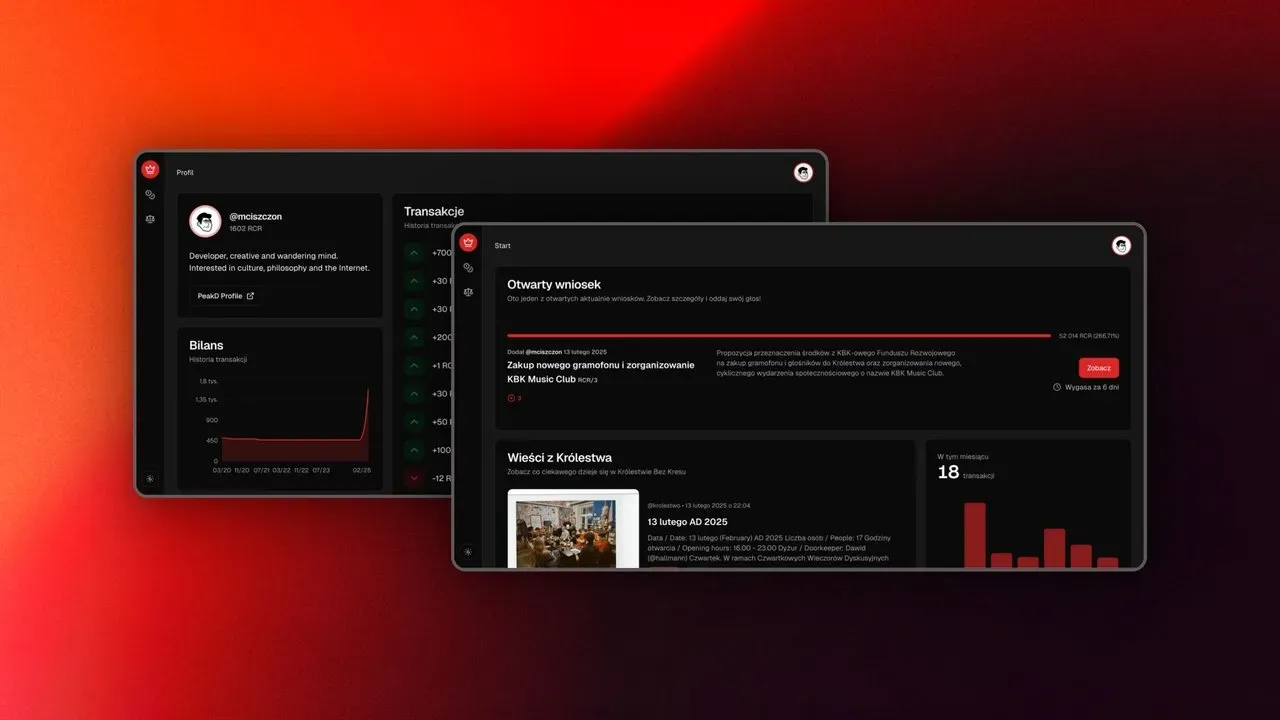
The application is available at: krolestwo.bezkresu.org.
Currently the application has several modules: a home page, a Rycar wallet and a motions system.
Home page
The home page displays the 5 latest posts from the Kingdom on the Hive platform. If there are open motions that can be voted on, information about them also appears here – thanks to this, users are encouraged to cast their votes.
Wallet
Every user has their own profile in the application, where they can see their current Rycar balance, as well as their transaction history (income and expenditure). Thanks to the list of all users, it is also possible to check other people's wallets and see what their voting power is.
Motions and voting
This is currently the most extensive module, which allows users to add their own motions concerning the Kingdom. After being added, a motion has 7 days for voting – during this time other users cast their votes (of support or opposition), and the system displays the current state of the vote. After 7 days have passed, the system automatically stops collecting votes and publishes the result of the vote. The whole thing happens automatically, so no intervention or manual counting of votes is needed.
The effects of the transformation
Although this is only the beginning of a long-term collaboration between Tesserakt and Królestwo Bez Kresu, positive effects of our work have already been achieved:
- Automating the onerous and repetitive tasks allowed the founder of the Kingdom to focus their time and energy on other strategic and operational activities.
- The visual presentation of the list of all users and their wallets had a motivating effect – the Kingdom's citizens engage more in volunteer activities in order to increase their voting power.
- Thanks to simplifying the process of submitting motions and voting, the Kingdom's community began submitting its first proposals for changes in the Kingdom.
- The introduction of the "News from the Kingdom" section makes it possible to convey updates without the need to "push" users from the application to the Hive platform.
The benefits of implementing the application are visible both to the founder of Królestwo Bez Kresu and to the community gathered around this place. Many of the Kingdom's citizens enthusiastically received the new system and suggested many additional functionalities – some of them will be introduced in the future.
Summary
The case of Królestwo Bez Kresu proves that blockchain technology can be successfully used to support the functioning of non-governmental organisations. Thanks to the skilful use of its database, social and economic features, ventures from the third sector domain can improve their operation, support community activity, and also offer opportunities that were previously difficult, if not impossible, to implement.
If you run a foundation, association or other non-governmental organisation and want to carry out a digital transformation – perhaps with the help of blockchain technology – write to us. We will thoroughly analyse your case and offer you a free one-hour consultation.


