

In the world of NGOs
The subject of non-governmental organisations is very close to the Tesserakt team. Many members of our company have experience founding NGOs or serving on their boards, which translates into a deep understanding of the specifics of this sector.
The social sector, often also referred to as the Third Sector or the NGO sector (non-governmental organisations), covers not-for-profit entities. It encompasses a wide spectrum of organisations whose goal is to carry out social, cultural or educational activities rather than commercial activity.
Third Sector organisations function in various legal forms – most often foundations and associations. However, this catalogue is much broader and also includes, among others, ordinary and registered associations, sports clubs, volunteer fire brigades, unions of associations, church organisations, informal groups, rural housewives' circles, social committees, the Red Cross, social cooperatives, political parties and trade unions – that is, all entities operating under separate legal provisions whose activity is not aimed at making a profit.
NGOs in numbers
In 2022, 115,500 registered non-profit organisations were operating in Poland. This represents an increase of 14,800 (i.e. 14.7%) compared to 2014.
Structure of the Polish Third Sector by Areas of Activity (2022)
Source: Report of the Central Statistical Office on Non-Governmental Organisations
In 2022, the largest number of non-profit organisations (24.5%) focused on sport, tourism, recreation and hobbies, with 78% of them being sports associations. The second largest group consisted of entities carrying out rescue-related activities (12.8%), which include volunteer fire brigades and other volunteer rescue units (WOPR, GOPR).
Relatively often, non-profit organisations indicated professional, employee and industry matters (12.7%) as their main area of activity, as well as culture and art (12.0%). The fewest entities, only 1.5%, operated in the area of law, its protection and human rights.
Source: NGO report "The Condition of Non-Governmental Organisations" from 2021
Our team focused on analysing the available data in order to identify the problems occurring in the non-profit sector and to study their proper functioning.
Statutory objectives of non-governmental organisations
Who drives the Polish non-governmental sector?
The "The Condition of Non-Governmental Organisations" report from 2021 indicates that excessive bureaucracy is one of the main obstacles for foundations and associations. This concerns primarily the complicated procedures related to obtaining grants and the extensive formalities in contacts with public administration. Interestingly, support for non-profit organisations from business is growing. Currently, two out of three organisations cooperate with private companies, and 63% of them declare having received support within the last two years.
Public funds remain the main source of financing for non-governmental organisations. This is a key aspect of their functioning, because most of them do not conduct business activity and need funds to pursue their statutory objectives. For this reason, grants, competitions and subsidies are often the most important source of funding for these associations.
Associations have many opportunities to raise funds by applying to projects. Below we present those that are most useful in seeking such opportunities.
National Freedom Institute – Centre for Civil Society Development (NIW-CRSO)
This is a key institution that manages many government programmes supporting non-governmental organisations, such as:
- The Government Programme Civic Initiatives Fund NOWEFIO
- The Government Programme for Supporting the Development of Advisory Organisations
- The Government Programme Youth Fund
- The Government Programme for Supporting Non-Governmental Organisations "The Power of Small Communities"
The NIW-CRSO website (niw.gov.pl/granty/) regularly publishes information about current competitions and programmes.
The NGO.PL portal
This is one of the most comprehensive portals for Polish non-governmental organisations. Here you will find the latest competitions, funding opportunities and detailed information about available funds (central, local government, EU and private). The portal also offers guides on how to effectively raise funds. Be sure to check the "Current competitions" section and subscribe to their newsletter to stay up to date!
ngo.pl (fundusze.ngo.pl/aktualne)
The European Funds Portal
This is the official website of the Ministry of Funds and Regional Policy, where you will find a grant search engine. There you can easily filter results by type of organisation, voivodeship and project field. It is also worth visiting the section with European Funds Information Points, where you can take advantage of free consultations.
Eurodesk Polska
This is a valuable source of information about EU programmes such as the popular Erasmus+, but also about national initiatives supporting young people and non-governmental organisations. Here you will find detailed information on how to apply, what the participation criteria are and what activities can receive support. Thanks to this, you can find funds for educational projects, youth exchanges, training or organisational development.
Other useful sources
- Ministry of Culture and National Heritage (gov.pl/web/kultura/dla-organizacji-pozarzadowych): Offers funding for non-governmental organisations operating in the field of culture.
- Local and regional portals for NGOs: Many cities and voivodeships have their own information portals for non-governmental organisations, where they publish announcements about local competitions and grants. An example is ngo.krakow.pl for Kraków.
Private and corporate foundations
Many Polish and international foundations and companies offer their own grant programmes. It is worth regularly checking the websites of large entities such as banks or telecommunications and energy companies, which often have CSR (Corporate Social Responsibility) departments and actively support non-governmental organisations. Examples of such initiatives are the programmes of the National Food Group S.A. Foundation "Pomaganie krzepi" or the Respect Energy Group.
Understanding the non-governmental sector, that is, the Third Sector, is crucial to fully appreciating its activity. These organisations are omnipresent in our daily lives, although we are often unaware of their key role in the functioning of communities.
An interesting point is the comparison of reports, which gives us an insight into how the sources of financing of the Third Sector have evolved.
- Public funds are still the largest source of financing for the non-governmental sector (44% of the budget), but their share is falling.
- The importance of donations is growing; they account for 26% of the revenue of all organisations, and an increasing number of them use this form of support.
- 42% of organisations actively carry out fundraising activities other than the traditional application for grants.
- In 2023, almost half (47%) of organisations applied for grants from city or municipal offices.
The Third Sector: basic data and characteristics
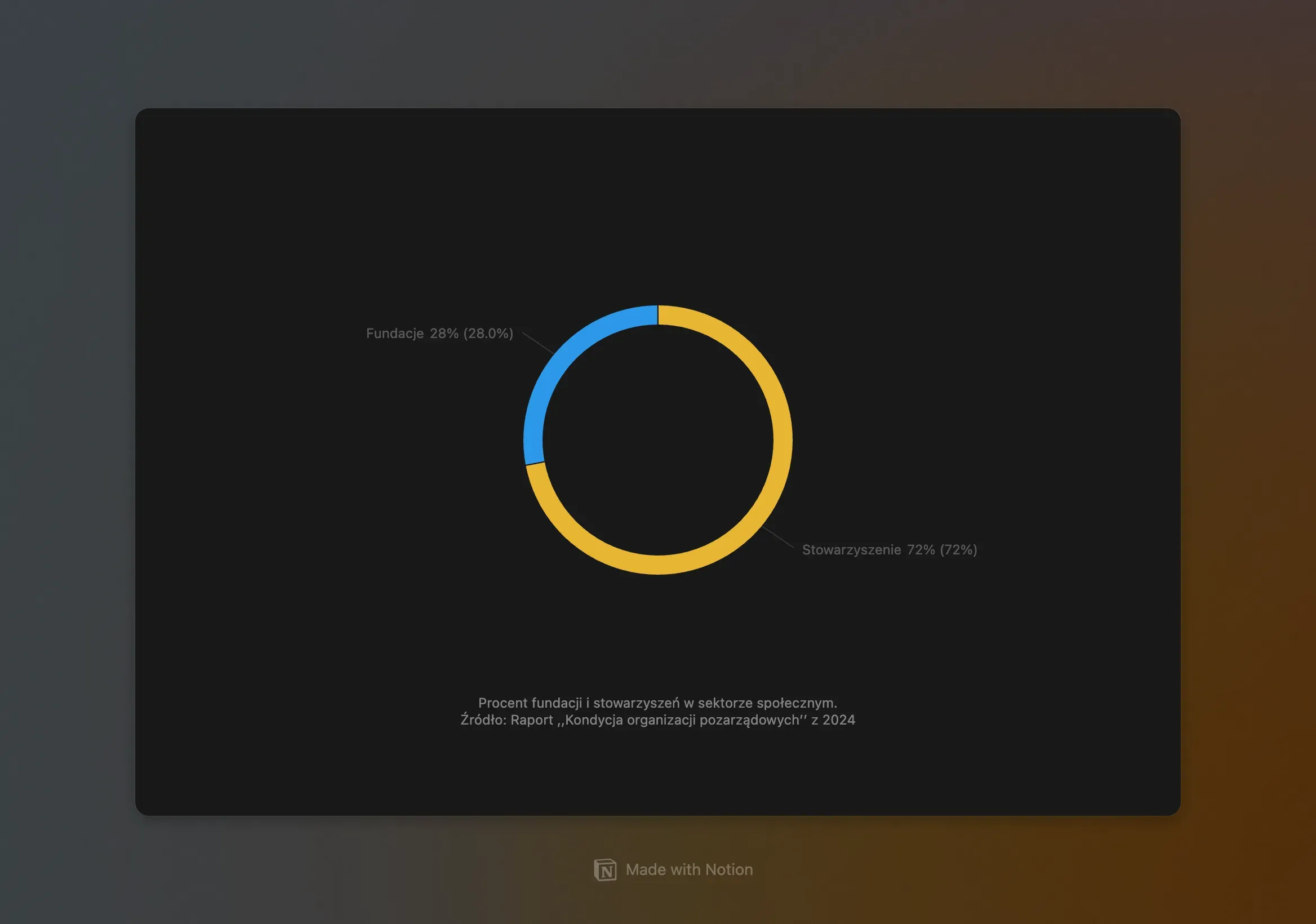
- 72% of non-governmental organisations are associations and 28% are foundations.
- Half of the organisations are located, that is, have their headquarters, in villages and small towns of up to 50,000 inhabitants, and 36% in cities with over 200,000 inhabitants.
- The average length of operation of an organisation is 11 years.
- The most commonly used methods of operation of organisations are organising events (69%), direct provision of services (65%) and information activities (45%).
- The beneficiaries of organisations' activities are most often children and young people (70%) and the local community (65%).
- 34% of organisations operate exclusively on a local scale, that is, of a municipality or county, and 40% carry out nationwide or international activities.
Unfortunately, the assessment of the situation and image of the Third Sector is not the best. As many as 63% of leaders of non-governmental organisations believe that most Poles still do not understand their activity. Moreover, 55% of them do not perceive the sector as a coherent community. Studies also showed that 52% of leaders see the influence of government policy on the financing of their activities from public funds.
Interestingly, the number of non-governmental organisations is changing dynamically. At the end of 2024, 161,000 non-governmental organisations were registered in Poland. This number included 117,000 associations (excluding volunteer fire brigades) and 44,000 foundations (data from the REGON register as of 31 December 2024). This variability results both from the creation of new entities and from others ceasing their activity.
Number of registered non-governmental organisations.
Source: Data based on the REGON register, as of 31 December 2024.
As can be seen, the number of registered non-governmental organisations is growing dynamically. However, around 75,000 of them carry out active operations, which accounts for around 50% of all registered entities.
The third sector in Poland: numbers, challenges and everyday reality
In 2022, 115,500 non-profit organisations were operating in Poland. The dominant areas of their activity were sport and recreation (almost 25%), followed closely by rescue services. It is worth noting that despite 161,000 entities being registered, around 75,000 of them are actively functioning. One of the main challenges these organisations face is omnipresent bureaucracy, particularly visible when obtaining grants.
Where does the financing come from?
The main source of financing for non-governmental organisations is public funds, although their share is gradually declining. Donations play a growing role, as does cooperation with private companies – currently two out of three organisations establish relationships with business. Funds are raised from many sources, including portals such as NIW-CRSO, ngo.pl, the European Funds Portal, as well as private foundations and corporations.
How do they operate and how are they perceived?
Most non-governmental organisations are associations (72%), and their average length of operation is 11 years. They most often focus on organising events, providing services and information activities. Their activities are primarily aimed at children and young people as well as local communities.
Unfortunately, the perception of the social sector in society is not ideal. As many as 63% of leaders believe that most Poles do not understand the essence of the activity of non-profit organisations, and more than half do not perceive them as a coherent community. In addition, government policy has a significant impact on their financing.
Despite these challenges, the Third Sector is omnipresent and plays an extremely important role in social life.
Tesserakt: from the non-governmental sector for the non-governmental sector
At Tesserakt we understand the specifics and challenges of the Third Sector like few others. We ourselves come from non-governmental organisations – our experts are former board members, founders and active activists of foundations and associations. Thanks to this, we have unique, practical experience and know perfectly well what public benefit entities face every day.
Today, using this knowledge and passion, we help non-profit organisations to grow dynamically. Regardless of whether you need support in raising funds, managing projects, building strategy, or dealing with bureaucracy – we are here to help you. Our goal is to strengthen the social sector and enable you to carry out your mission more effectively.
Do you want your organisation to operate more efficiently and achieve more? Contact us to talk about how Tesserakt can support the development of your activity!
Sources:
- Central Statistical Office
- NGO.pl
- The Condition of Non-Governmental Organisations report from 2021
- The Condition of Non-Governmental Organisations report from 2024


