


In the digital world of the 21st century, content management systems have become the foundation of how millions of websites operate. Among them, WordPress remains the clear leader, powering more than 40% of all websites. Those 750 million active sites worldwide are the result of WordPress often being the simplest and shortest path to creating an online presence.
For entrepreneurs just starting out, WordPress is frequently seen as a tool that allows them to eliminate digital debt, that is, to increase their visibility online, often improve their image and the accessibility of their offer.
The ability to create a professional and aesthetic website without committing a large budget or having advanced programming knowledge makes WordPress automatically the first choice for small and medium-sized companies that want to establish a presence on the Internet in a short time.
However, as a business grows, the tool meant to pay off digital debt starts generating new problems. Vulnerabilities to hacker attacks, abandoned plugins, difficulties with updates. Over time, these problems pile up and take the form of a new debt – this time called technological debt.
In this article, we will answer the question of how to avoid WordPress's problems by using more modern approaches and technologies. First, however, let us consider exactly where WordPress's success came from.
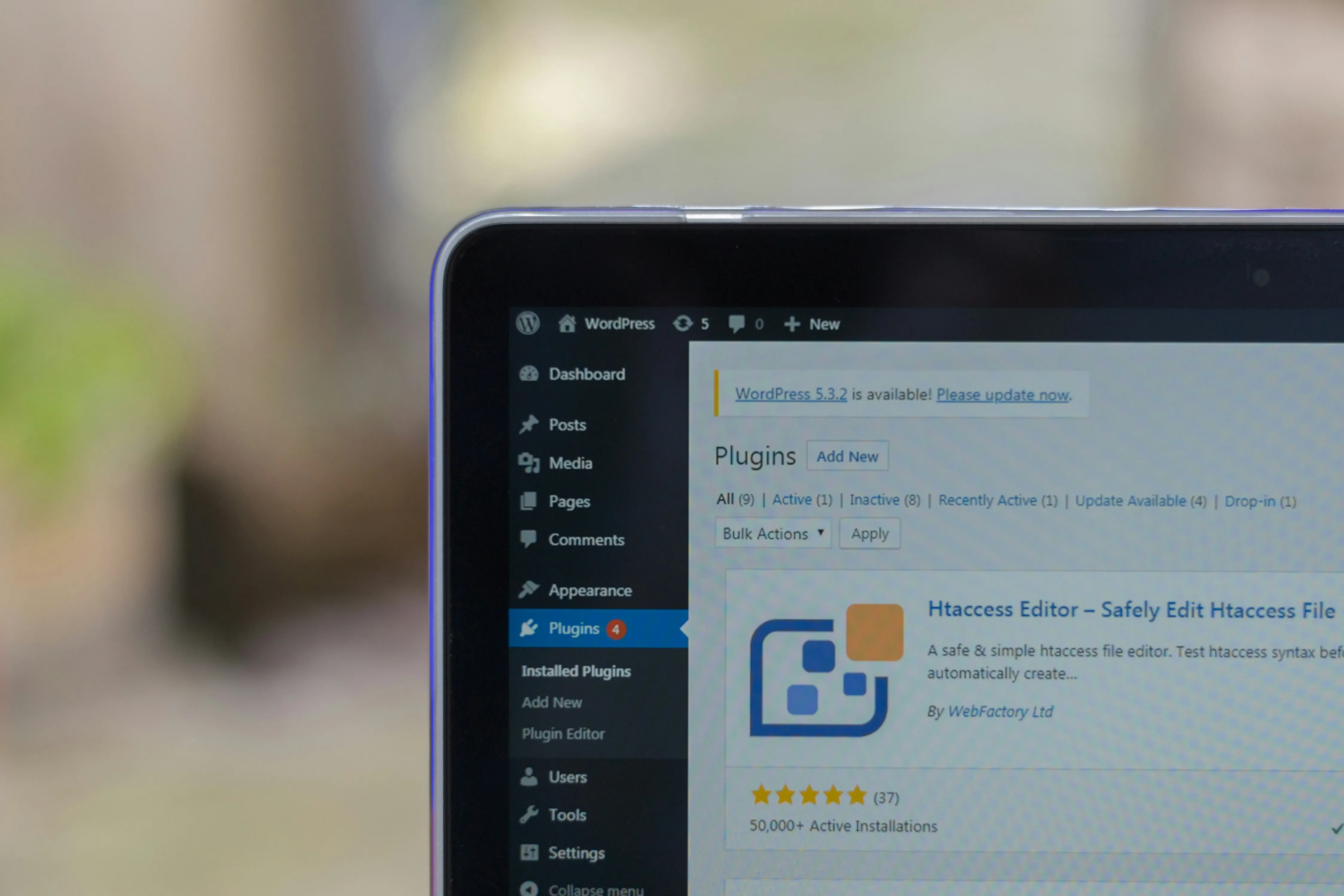
The foundations of WordPress's success
WordPress is one of the oldest still actively developed CMS systems. Its official beginnings date back to 2003, and at one time it revolutionised and democratised the content management ecosystem. Its main advantages are:
Availability for free
From the start, the WordPress system was offered for free – including for commercial projects. Thus the initial implementation costs are limited solely to the purchase of a domain and basic hosting.
In addition, the user encounters a simple installation process, as well as an intuitive administrative panel, which do not require specialist technical knowledge. WordPress operates with drag and drop editors, which allow you to create complex graphic layouts without technical experience.
A rich ecosystem of plugins and extensions
A huge advantage of WordPress is its system offering more than 60,000 free and paid plugins. There are also thousands of themes allowing for deep personalisation of a site's appearance and functionality. Add-ons can radically change the character of a site, transforming a blog into an online shop, a portfolio gallery or a booking platform.
The open-source model and community support
Such a rich spectrum of extensions would not have come about without a vast and active community of users and developers. This community creates most of the plugins and themes and provides support through forums, tutorials and documentation. WordPress's open source code fosters collaboration, which enables the platform's constant development and adaptation to the needs of the digital world.

The real risks of WordPress
Paradoxically, it is precisely WordPress's popularity and capabilities, which are its strength, that become its greatest weakness. The lack of a native, dedicated team looking after security across the entire ecosystem makes the platform a prime target for attacks.
Wordfence's 2024 report reveals that 8,223 vulnerabilities were published during the year, a 68% increase compared to 2023. An analysis of this data points to a key problem. Only 5 of these vulnerabilities concerned the WordPress core, while as many as 96% of them were related to plugins and themes.
This situation stems from the fragmented nature of the ecosystem. Each plugin developer works independently, often without sufficient resources to continuously monitor and fix code for security. As a result, popular plugins used by millions of sites can contain vulnerabilities that become a gateway for hacker activity.
The most common types of vulnerabilities disclosed in 2024 were:
- Cross-Site Scripting (XSS) – accounted for 46% of all disclosed vulnerabilities. This attack allows malicious code to be injected into a site, which can lead to the theft of user data.
- Missing authorisation – the second most common vulnerability, which allows unauthorised users to access functions intended for administrators.
- SQL Injection – these attacks affect 1.57% of WordPress sites due to security flaws. They allow data in the database to be manipulated or deleted.
Security plugins only ostensibly solve the problem, operating inside the site rather than as an external firewall. Outdated software, weak passwords and a lack of regular updates remain the main targets of attacks.
Performance and scale not for WordPress?
WordPress's architecture and excessive reliance on plugins lead to performance and scalability problems. Each plugin adds functionality but generates an additional load on the server and the user's browser, slowing down the site's loading time.
Slow-loading pages are a problem for Google and for audiences, negatively affecting SEO and the user experience. Quick and simple solutions, such as installing yet another plugin, create the aforementioned technological debt. We get an immediate effect at the cost of compatibility and stability problems in the longer term.
As traffic and the number of transactions grow, WordPress can encounter serious performance limitations. It is not recommended for large e-commerce platforms, social platforms or portals with a large number of users. Its architecture is not adapted to scaling in real time and handling complex logic processes. For such a scenario, no optimisation or number of plugins will be able to overcome the platform's fundamental limitations.
The apparent savings of WordPress
The WordPress core is free, but full personalisation and adaptation to business needs becomes costly. Implementing unique functions, a custom appearance and integration with other systems often requires paid plugins or the use of professional software developer services.
Moreover, WordPress's code architecture makes it difficult to efficiently extend its functionality. Thus the initial saving diminishes, and the total cost of implementation and maintenance can be equal to or often higher than dedicated solutions.

Modern alternatives
While a dozen or so years ago the landscape of available technologies and solutions was much poorer, today we have at our disposal a wide range of approaches, solutions, technologies and tools that make it easy, fast and cheap to solve business problems without getting entangled in the limitations imposed by WordPress.
New technologies
Once, almost all CMS systems were based on the PHP scripting language and a MySQL database, and every visit to a site required a significant amount of work by the server to generate an HTML response. Moreover, the interactivity of websites was heavily limited by the JavaScript language and imperfect tools such as jQuery.
Today we still have at our disposal many platforms based on PHP, which has undergone significant evolution, but systems built entirely in JavaScript have also gained popularity. There is also a sizable group of alternative solutions based on languages such as Python or Go.
Tailor-made solutions
Each of these technologies offers certain benefits and comes with certain limitations – but as a rule, more choice is beneficial, because it allows you to match a solution to a specific problem.
In this context, WordPress presents itself as a platform "for everything" – at the cost of not being particularly good at any aspect.
Static site generators
One of the problems with WordPress and other similar content management systems is the server-side rendering model. This means that every time a user visits a site, the server has to generate its HTML content before it is returned to the browser. Along the way, there are dozens, sometimes hundreds or even thousands of database queries and various operations performed by the server.
All of this results in longer page loading times and significant loads on the infrastructure. However, these loads are completely unjustified, because the vast majority of website content is static in nature.
What does that mean? While functionalities such as online shops require dynamic updates – e.g. stock levels – content such as an "about me" page or even a blog changes relatively rarely and can easily be generated once and delivered to the user in that prepared form.
This allows for significant resource savings and speeds up site loading times for users. Such improved loading times also mean better SEO results and a higher ranking in Google.
Astro
At Tesserakt, when building websites and even more advanced sites (shop functionality or online platforms) for clients, we very often decide to use the modern modern Astro framework.
Astro supports both the server-side page generation model and so-called pre-rendering – that is, the page is prepared only once and then served as a static file.
Moreover, both of these models can be combined within a single website. This makes it possible to implement, for example, an online shop without harming the speed of the other subpages.
Astro is also an extremely lightweight and modular framework, which makes it easy to extend it with additional functionalities and integrate it with other systems – without the need to rely on untrusted plugins and with full control over the resulting software.
It is worth reading the post From WordPress to Astro + Sanity: Why Our Agency Made the Switch, in which the creators of the Digital EMPR web agency described their experiences of switching from WordPress to Astro and the Sanity CMS system.
Modern CMS systems
It is also worth pointing to alternative content management systems that can successfully replace WordPress and also deliver many additional functionalities.
For many simpler static websites, the full range of functionality is provided by easy-to-use and completely free systems such as Keystatic, Pages CMS or the somewhat more advanced Sveltia. It is worth noting that all three platforms are developed on an open source model – just like WordPress.
For more advanced projects, we have at our disposal many more complex platforms, yet still offering a convenient and intuitive user interface, ease of implementing new features and full control over the software code.
An example of such a more advanced system could be Directus. It is a platform belonging to the family of so-called "headless CMS" – this means that Directus is a fully functional content management system, but in itself it does not have the functionality of generating websites.
Instead, Directus focuses 100% on convenient content creation by editors and on making that content available through various channels (e.g. API programming interfaces). This content can then be used to power a website built, for example, with Astro, but not only – the same content can successfully power other sites, mobile applications, and even social media ads.
Directus's advanced capabilities mean that it can be used not only to create a simple site, but also an online shop, an advanced online store or even any other application. A list of 100 example applications that can be built with this system is available in this article: 100 Tools, Apps, and Platforms You Can Build With Directus
The Tesserakt homepage
We also used the technologies described above when creating our own website, the very one you are on now. As a result, our site is lightweight, loads quickly, achieves good SEO results and is childishly simple for people editing content.
Our site is also constantly being edited. Time and again we add further sections, functionalities and integrations. At the same time, these changes do not involve a huge workload – the site is modular, easy to extend and to integrate with other systems.
One such integration is connecting our contact form with a CRM system. As a result, when our clients contact us, they go straight into our CRM, which allows us to easily track the sales process and subsequent support.
Tess Themes
At Tesserakt, we are aware of the reasons why WordPress became the dominant CMS system in the world. People and companies around the world love WordPress for the ability to launch a site at a very low cost. However, we also understand perfectly the serious inherent problems and limitations of this platform.
Therefore, we decided to offer a solution that has the advantages of WordPress without duplicating its flaws, and also uses modern technologies.
We launched a collection of ready-made website templates that use Astro as the site generation engine and lightweight, modern and free content management systems such as Keystatic.
Moreover, we also offer additional services, such as template customisation, SEO optimisation, etc. This means that at a very low cost you can launch your own website based on modern technologies, meeting optimisation and SEO requirements.
We encourage you to explore the Tess Themes offer at themes.tesserakt.dev.
How to choose the right solution for your business?
The choice of an appropriate CMS system should be dictated not only by current needs, but also by a future vision of business growth. Below are the key questions that everyone should answer before deciding on a CMS.
Key aspects:
What budget does the company have to start with, and what for long-term maintenance, development and personalisation?
At the initial stage, companies often choose the lowest possible costs that will allow for quick implementation. However, it must be remembered that this does not mean being doomed to use a single technology that imposes numerous limitations. The tools currently available make it possible to implement effectively without losing quality and security, while at the same time offering a simplicity of CMS operation that can easily be compared to what, for example, WordPress offers. This approach is particularly crucial for entities that care about the ability to scale their business, whether online or offline.
Does the project have a chance to develop quickly, gaining a large number of users or transactions?
This is definitely a key aspect when choosing the technology for building a site, one that in fact determines the ultimate tool. In this case, two parameters are decisive: the site's throughput and the security we can provide to Users. Since both of these elements translate in real terms into revenue, it is good to choose a system that can handle them without problems.
What data will be stored and what level of security is required?
In this case, a simple rule should be followed – the more sensitive the data to be stored, the more one should choose technology that receives updates and has good security mechanisms. In the case of WordPress, there are many security holes, and using plugins only increases the complexity of the system. Modern technologies such as Astro or Directus CMS allow for full control over data and its flows.
Will the website need to connect with other systems (e.g. CRM, ERP)?
The integrations that occur on websites are often literally the brain without which the site would have no reason to exist. It is therefore worth ensuring that the chosen technology is characterised by flexibility and stability that will allow for easy synchronisation, whether through the use of ready-made plugins or APIs. As the complexity of the ecosystem grows, so does the importance of compatibility, as well as the security offered by the CMS.
Who will manage the site on a daily basis?
A marketing team? An editor? Or perhaps people with extensive technical experience? Some systems are characterised by a high degree of intuitiveness and friendliness for non-technical personas, while others offer advanced features for which programming knowledge is indispensable.
Will the platform require significant expansion in the future, and what functionalities will be necessary to use it?
Scaling a business almost always involves the development of the tools the company uses every day. In the case of a website, this development may mean, for example, new sections, additional modules, e-commerce activities, or even more advanced integrations with other systems. A CMS should be characterised by such a degree of flexibility that it allows changes to be made while maintaining full functionality for the user, without the need to migrate to another platform.
Investment in technology versus business growth
For years, WordPress was the natural choice for many companies starting an online business. Its simplicity and low price convinced many users. However, as a business grows and the requirements of e-commerce, security and performance increase, it often fails to keep up with the needs of modern organisations.
Data security and site speed are becoming the foundation of customer trust and brand recognition. WordPress in its traditional form rarely guarantees both of these elements at an appropriate level. That is why the importance of modern solutions that ensure stability, scalability and security is growing.
If you are facing the challenge of creating an optimised and secure system for your company – contact us. We will help you create a site that is secure, fast and future-ready.


